
Published: 17 October 2026
How to Avoid Fees When Spending Money Abroad
Using the wrong debit or credit card abroad can be an expensive mistake.
Many UK banks and credit card providers still charge around 3% every time you spend in a foreign currency. Some debit cards also add a fixed fee for each transaction, while withdrawing cash from an overseas ATM can trigger another set of charges.
Individually, these fees might not seem particularly significant. But over a two-week family holiday, paying for meals, drinks, activities and accommodation can quickly add £50 or more to the cost of your trip – without you receiving anything extra for your money.
Fortunately, avoiding most of these charges can be a relatively straightforward process. There are plenty of credit and debit cards that allow you to spend abroad without foreign transaction fees, and a little preparation can also help you avoid expensive exchange rates and unnecessary cash withdrawal charges.
In this guide, we explain the different ways of spending money abroad, the hidden fees to watch out for and how to get the most from your money. We’ll also share the combination of credit cards and bank accounts we personally use when travelling, including how we balance avoiding fees with earning Avios and cashback.
Understand the fees your bank charges abroad
| Charge | What it means |
|---|---|
| Foreign transaction fee | Often around 2.75–2.99% of the amount spent |
| Fixed purchase fee | Some debit cards charge an additional amount per transaction |
| Overseas cash withdrawal fee | A percentage or fixed charge when withdrawing cash |
| ATM operator fee | A separate charge imposed by the owner of the cash machine |
| Dynamic Currency Conversion | A potentially poor exchange rate when choosing to pay in pounds |
The worst cards can change you nearly 3% in foreign exchange fees, £2.00 every time you withdraw cash out of a machine and £1.00 each time you use your debit card abroad. Go on holiday for a fortnight, withdrawing small amounts of cash each time or putting lots of different transactions through on a debit card, can see the charges really mount up.
Before travelling, check your bank’s charges for both card purchases and cash withdrawals. These are not necessarily the same, and a card that is cheap to use in shops might still be expensive for withdrawing cash.
Credit Cards
Many standard UK credit cards add on a 2.99% foreign exchange fee for non sterling transactions. Spend £1,000 meals & drinks on a family holiday and that is another £30 on the cost of your trip. Settle the hotel bill and pay for activities for the kids and the fees really add up.
If you get a specialist travel credit card that does not have any foreign exchange fees you can save this money straight away. There are various credit cards on the market without an annual fee so do some research and pick the one that works best for your situation.
Another advantage of using a credit card is Section 75 protection. Qualifying purchases costing between £100 and £30,000 can be covered if the supplier breaches its contract or misrepresents what you’re buying, including certain purchases made overseas.
Hotels and car-hire companies frequently place a temporary hold on a payment card to cover deposits or incidentals. Using a debit card can temporarily tie up money in your current account, while using a credit card generally reserves part of your credit limit instead. For many people, this alone can be a reason to get a travel credit card.
If you do use a credit card on holiday, you should always pay the bill in full when you return as interest charges will likely outweigh any savings made on the exchange rate.
Do not withdraw cash on a credit card unless it is an absolute emergency. You will likely pay a 3-5% cash handling fee plus interest charges from the day the cash is withdrawn.
You will struggle to find a free card with no foreign exchange fees that also awards miles or points on spend. The exception appears to be the Virgin Atlantic Reward Credit Card which gives 0.75 Virgin Points per £ and does not charge any fees on purchases in Euros, Swedish Kronor, or Romanian Lei made whilst inside the UK or the European Economic Area. There are some other cards that offer small amounts of cashback too.
Which? has a comparison article here.
Business Travellers: if you are travelling for work, you may be less inclined to use a specialist travel credit card and focus more on earning miles & points. See our guide to maximising your work travel here.
Debit Cards
Like credit cards, some banks charge a 2.99% fee for spending in a foreign currency. Furthermore, accounts such as the TSB Spend & Save can charge an additional fixed fee of £1 per transaction. This means that you could end up paying £3.06 for a coffee costing £2 in local currency!
Avoiding these sort of charges is relatively easy by opening a bank account that offers a Debit card without foreign exchange fees. There are many different ones available and sites such as Which? identify the best accounts on the market.
Prepaid cards
Many people prefer to use a prepaid card which enables them to better control their expenditure whilst abroad. You transfer money to the card before you go and then spend in local currency in the same way as a debit card, or withdraw cash from a local ATM.
Unlike cash, prepaid cards usually offer an additional level of security as lost/stolen cards can be blocked plus PIN numbers are required for larger transactions.
Many prepaid cards also offer the ability to “lock-in” an exchange rate before departure which may appeal to some people who want the security of knowing exactly what things will cost.
Rates are generally more competitive than a standard debit card (which will usually add a 2.99% fee) but are usually not quite as good overall as a specialist travel credit or debit card.
Section 75 protection is not offered with prepaid cards.
Prepaid cards are rife with additional fees. Most will typically have a one off delivery or activation charge of around £5 which seems fair enough but other extras can include monthly fees, charges for topping up your balance, cash withdrawal fees, charges for months when the card is not used and fees for moving any unused money back into your normal bank account.
Dynamic Currency Conversion
When using a credit or debit card abroad, or when withdrawing cash from an ATM, you may be asked if you wish to pay in pounds instead of the local currency – a process known as Dynamic Currency Conversion. Always pay in the local currency, you will be getting the official Visa or Mastercard rates rather than paying an exchange rate with an extra 3-8% markup added by the retailer & their bank.
If you choose to pay by contactless card, just check on the payment terminal that you are paying in the local currency. An unscrupulous retailer could be tempted to select a payment in £s and you will likely not realise you have been overcharged until you return home.
Other card tips
If you pay on your phone using Apple Pay or Google Pay, you can usually immediately see the amount that has been charged to your card straight away, which can help you better control your spend when abroad.
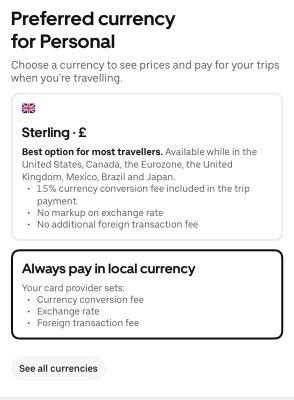
Make sure you have international apps such as Uber set to pay in the local currency. Otherwise you will end up paying additional charges.
Using cash abroad
Whilst card acceptance has increased significantly over the past 10 years, some destinations are still more cash focused. Also many travellers prefer to use cash to help them budget for their trip.

Withdrawing Cash
As with credit and debit cards, additional fees for cash withdrawals and foreign transactions are commonplace with some bank accounts (TSB Spend & Save being the worst example) charging 1.5% (minimum £2.00) plus 2.99% foreign transaction fee to withdraw money. Withdraw the equivalent of £20 abroad and TSB will be charging your account £22.60…
Avoid all this by getting a bank account that does not charge additional fees to withdraw money from foreign cash machines. Even if you just use for when you are out of the country, you can transfer cash in from your main account when you need it and then move any unspent money back when you return home.
Just because your account does not charge foreign currency fees for debit card spend, do not assume that there are no fees for withdrawing cash from that same account when abroad. Make sure you find an account that does not charge for debit card spend AND cash withdrawals.
Foreign ATM charges
Careful where you withdraw cash as even if your bank does not charge you, the foreign bank may well add a fee for using the machine. Generally, you are less likely to pay to withdraw cash in a bank operated ATM, although this is definitely not a hard and fast rule.
Exchanging Cash
If you are home or abroad, there is never a shortage of places to change your money into foreign currency. Comparison sites are available to help you understand the rates available but some places will often have a different exchange rate on the high street compared to what is showing online.
The main rule here is never, ever exchange money at an airport as despite the convenience, using their walk-up rates will usually mean getting around 15% less foreign currency for your sterling than you would have otherwise received on the high street.
However, pre-ordering in advance for collection at the airport can actually be really competitive. I have collected pre-ordered currency from Travelex at Newcastle airport on many occasions in the past and have found the online rates to be decent value, and far better than those available to walk-up customers.
These days, commission charges for exchanging cash are less common than they were years ago but they are something to be aware of, especially when you are abroad.
Cash Tips
Budget for your cash use and do not end up taking any significant amounts of cash home, unless you definitely know you will use it in the future. You can always use any bits of cash left as part payment for food, drinks or duty free in the airport and pay the balance on a card.
Do not withdraw cash on a credit card as you will likely pay a one off fee plus interest will be incurred from the time you made the withdrawal.
My Travel Money Strategy
UK Spend
British Airways Premium Plus American Express credit card
- £300 annual fee
- 1.25 Avios per £
- A companion voucher for a BA reward flight after spending £15,000 a year
- Also earns BA tier points
Foreign Spend (plus places in the UK that do not accept Amex)
MBNA Horizon Visa credit card
- No annual fee
- Zero foreign exchange fees
- 0.5% cashback on all spend
Travel Bank Account (transfer cash in/out when needed)
Starling Bank
- No annual fee
- Mastercard debit card
- Zero fees for spending abroad
- Zero fees for cash withdrawals
Our Take
There is little reason to pay unnecessary banking fees when travelling abroad. With a little preparation, most of the charges associated with foreign currency spending and cash withdrawals can be avoided entirely.
The first thing we’d recommend is to check the overseas charges on your existing debit and credit cards. You might already have an account that offers fee-free foreign spending, but if not, there are plenty of alternatives available without an annual fee.
Our preferred approach is to have a separate strategy for spending abroad rather than relying on the cards we normally use in the UK.
For everyday purchases, we favour a credit card with no foreign transaction fees. This allows us to avoid the typical 2.99% surcharge while still benefiting from the convenience of paying by credit card. Our MBNA Horizon card also earns cashback, although this is an existing account rather than necessarily an option available to new applicants.
We also maintain a separate bank account for overseas cash withdrawals. This means we can transfer money into the account when needed, withdraw local currency without additional charges from Starling and avoid exposing our main current account to unnecessary risk while travelling.
However, having the right cards is only part of the equation.
Always choose to pay in the local currency rather than pounds when using a card or withdrawing money from an ATM. Watch out for fees imposed by overseas cash machine operators and avoid exchanging cash at airport walk-up counters.
We would also recommend taking more than one payment card, ideally from different providers. Cards can be lost, blocked or occasionally refused, and having a backup can save a lot of inconvenience.
If you prefer to use cash, there’s nothing wrong with that either. Just plan roughly how much you’ll need and avoid returning home with large amounts of foreign currency that you may struggle to use.
Finally, don’t become so focused on earning miles or points that you overlook the fees involved. Earning Avios on overseas purchases might sound attractive, but paying nearly 3% in foreign transaction charges to earn rewards worth considerably less makes little financial sense.
Our advice is to use the right card for the right transaction, avoid unnecessary currency conversion charges and keep a backup payment method available.
A few minutes spent reviewing your cards before travelling could save you a decent amount of money over the course of a holiday.